Author Archive

VIZBI 2021 Program Online

Monday, January 25th, 2021

The complete program for VIZBI 2021, the 11th international meeting on Visualising Biological Data, is now online. VIZBI 2021 will be an EMBL Virtual Conference, taking place online from March 24-26, with sponsors including ISCB’s BioVis COSI. The conference features keynotes from Daniel Weiskopf (U. Stuttgart, Germany), Fabian de Kok-Mercado (HHMI, USA), and Petra Isenberg (Inria, France), as well as talks from 18 leading researchers, reviewing how data visualization is transforming life science research.

To join the meeting, visit the VIZBI Registration page. This page also outlines opportunities for childcare grants and registration fee waivers.

NVIDIA Award for Best Scientific Poster

Thursday, February 11th, 2016

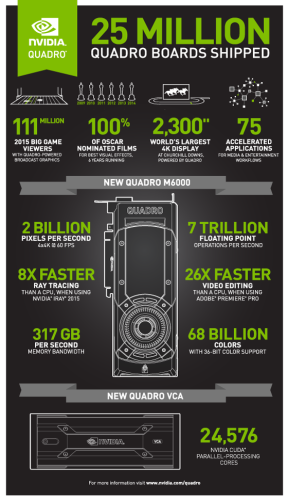
M6000 infographicWe are pleased to announce that – as with previous years – NVIDIA have agreed to sponsor a generous prize for the poster that best exemplifies the use of data visualization to gain clear, compelling insight into an important scientific problem. The award winner will receive a Quadro M6000 card, one of the world’s most powerful GPUs, making real-time photorealistic rendering possible for even complex scenes. It can drive up to four 4K displays simultaneously, and its 3,072 CUDA cores make it perfect for many scientific applications. To upload your poster, use the submission link in your VIZBI registration email. Accepted posters will be published in the VIZBI poster gallery. The deadline for upload is February 26 at 23:59 CET (deadline has been extended).

VIZBI 2015 Tutorial Day

Saturday, February 7th, 2015

The early bird registration for VIZBI is closing after today, 7th of February 2015. Have you decided which two from the twelve tutorials you’ll sign up for this year? Below is a brief reminder of what’s on offer.

MORNING SESSIONS

In the morning session of the VIZBI 2015 tutorial day you can choose from the following six tutorials:

Terri Gilbert’s
Engaging with the Allen Brain Atlas resources

Terri Gilbert’s Engaging with the Allen Brain Atlas resources

Gael McGill’s
Crafting dynamic molecular animations
with Molecular Maya & Clarafi.com

Gael McGill’s Crafting dynamic molecular animations with Molecular Maya & Clarafi.com

Keiichiro Ono’s
Network visualization and analysis workflows with Cytoscape

AFTERNOON SESSIONS

Among the afternoon’s six offerings you can find single tool/group tutorials as well as three thematic tutorials, which combine tools developed by different groups. Like above, clicking on each title will take you to the tutorial description on the program page.

Genomes in 3D Juicebox, TADKit and Genome3D
Neva C. Durand, Jim Robinson, Mike Goodstadt, Marc A. Marti-Renom, Jim Zheng and Jijun Tang

Genomes in 3D Juicebox, TADKit and Genome3D Genomes in 3D Juicebox, TADKit and Genome3D

Reuse, develop and share biological visualisation with BioJS
Manuel Corpas, Tatyana Goldberg, Guy Yachdav, Sebastian Wilzbach and David Dao

Reuse, develop and share biological visualisation with BioJS

Spatially realistic single-cell models from high-content microscopy data
Jacob Czech, Greg Johnson, Bálint Antal and José Juan Tapia

Spatially realistic single-cell models from high-content microscopy data Spatially realistic single-cell models from high-content microscopy data

Spatially realistic single-cell models from high-content microscopy data

Garuda – The way biology connects
Samik Ghosh, Hiroaki Kitano and Yukiko Matsuoka

Garuda - The way biology connects

Call for discussion topics for VIZBI 2014 Breakouts

Tuesday, February 18th, 2014

VIZBI 2014 delegates can now propose and vote on topics for discussion during the two unconference breakout sessions scheduled after the afternoon coffee break on Wednesday 5th and Thursday 6th March.

This will be the second time that we have run these un-conference style group discussions. The VIZBI 2013 breakout session included discussions on ways of improving visual communication in papers, dealing with ‘balls of yarn’, and exploring highly variable regions in sequencing data. It also provided an opportunity for community building – and two of the biggest groups discussed the 2013 BioVis contest and the collaborative development of javascript libraries for biological visualization. One of the most important parts of an unconference is that discussion doesn’t take place behind closed doors. Delegates can move between groups until they find a topic they’d like to sit in on, and representatives are elected to present lightning talks the following day.  These allow everyone attending VIZBI to hear the results of each discussion.

With two unconference breakout sessions this year, and a Heidelberg Unseminars in Bioinformatics meeting on the evening of the tutorial day, there are lots of opportunities for you to get together with like-minded members of the biological visualization community for constructive discussion. So, if you are coming to VIZBI 2014 and have a topic you want to explore, then check your inbox for the link and propose your topic now!

Abstract submissions now open for iEvoBio 2011

Thursday, February 17th, 2011

Rod Page, who will speak during the Population data session at this year’s VIZBI, is also involved with iEvoBio, a conference on Informatics for Phylogenetics, Evolution, and Biodiversity, which – like VIZBI, is now in its second year.

iEvoBio 2011 will take place in Norman, Oklahoma, in the US, from the 21st to the 22nd June, and is now accepting submissions for informatics talks concerning new tools, cyberinfrastructure development, large-scale data analysis, and visualization. iEvoBio and its sponsors strongly support open-source software development, and where appropriate, submissions must provide full details of their software’s licensing terms.

The submission deadline for full papers is 18th March 2011. For further details, please go to http://ievobio.org/ocs/index.php/ievobio/2011.